What makes Indian Creek feel so different from the rest of Miami’s luxury market? It starts with the fact that this is not a typical waterfront neighborhood at all. If you are buying or selling here, you are stepping into a tiny, tightly held island market where scarcity, privacy, and structure shape almost every decision. In this guide, you will see how Indian Creek works, why inventory is so limited, and what that means for pricing, strategy, and due diligence. Let’s dive in.
What Indian Creek Actually Is
Indian Creek is an incorporated village in Miami-Dade County, not simply a neighborhood name used for marketing. According to the village, it covers about 0.46 square miles, or 294 acres, on a man-made barrier island in Biscayne Bay. That municipal structure matters because it gives the island its own government, public safety framework, and land-use rules.
Just as important, Indian Creek is intentionally small by design. The village’s 2025 Comprehensive Plan states that it may permit no more than 41 single-family principal dwelling units. It also states there is no commercial, industrial, or multi-family development, which helps explain why the market behaves more like a finite collection of legacy assets than a normal residential submarket.
Why Supply Stays Exceptionally Tight
Inventory in Indian Creek is limited because the island is physically tiny and policy keeps it that way. The village describes 41 platted waterfront home sites, and the official planning framework preserves the island as a single-family, recreation-oriented environment. In practical terms, that means there is no meaningful path to future expansion.
For buyers, this creates a market where opportunities may appear rarely and move on unique timelines. For sellers, it creates a very different positioning challenge than you would see in a larger luxury area with more frequent turnover. Every listing or quiet offering enters a market where the supply story is already one of the strongest value drivers.
How Access Shapes the Experience
Part of Indian Creek’s appeal is its self-contained layout. The village’s planning documents say the island connects to Surfside via the Indian Creek Bridge and then continues onto a 1.6-mile private two-lane roadway. The village also notes that residences and the club connect solely to the mainland through the Surfside Bridge over the Indian Creek waterway.
That access pattern is not just a detail on a map. It contributes to the island’s private, controlled feel and affects how people think about arrival, circulation, service access, and day-to-day logistics. In a market like this, the physical approach to the property becomes part of the ownership experience.
Why Waterfront Matters So Much
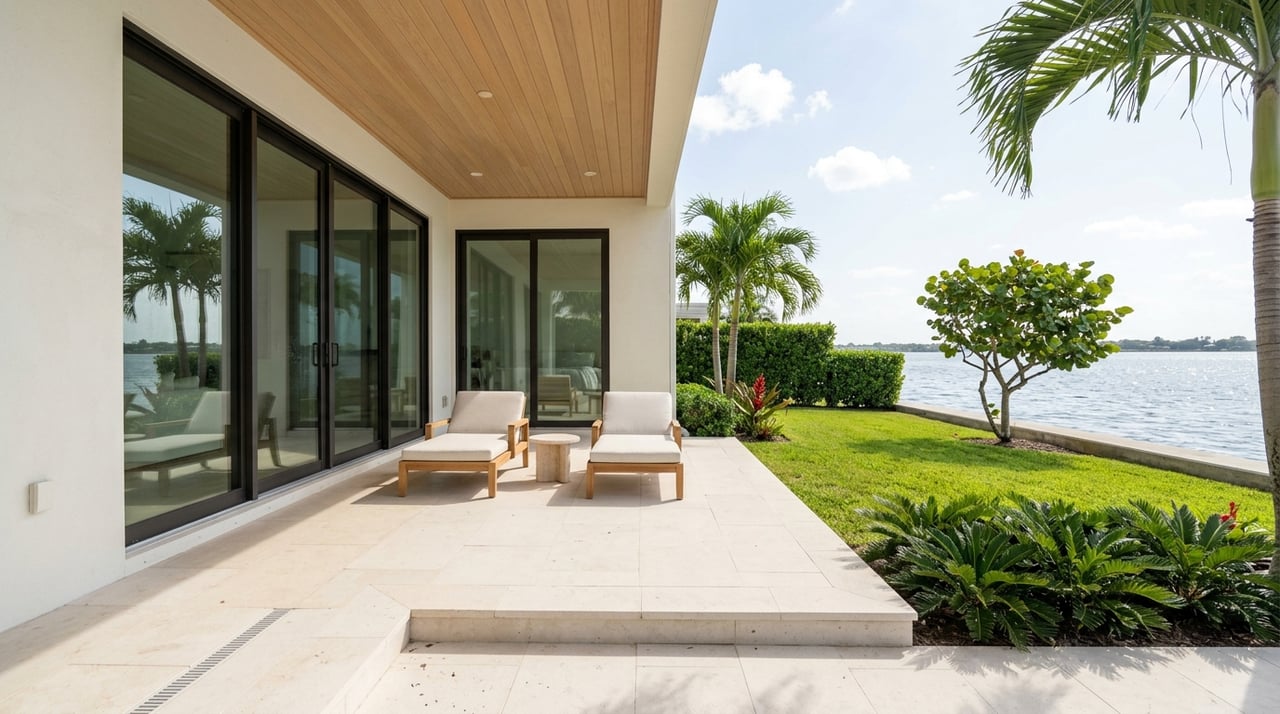
Indian Creek’s residential sites are overwhelmingly defined by water frontage. The village states that all residential lots have water frontage, and it notes that the canal is tidally influenced. This waterfront orientation shapes architecture, lot utility, views, and the buyer pool.
It also adds a layer of due diligence. The village notes flood-zone conditions across the island, even though its 2025 plan says no part of Indian Creek lies in the designated Coastal High Hazard Area. If you are evaluating a property here, waterfront profile and flood context are central pieces of the analysis.
Why the Country Club Is Central
The Indian Creek Country Club is not a side amenity. The village says the balance of the island is occupied by the club, which includes a clubhouse, a members golf course, dockage, and event facilities designed by Maurice Fatio in 1929. That means the club is part of the island’s physical structure, not just an optional lifestyle extra.
The club’s public-facing information also shows a members-only operating model. Its website references a members-only area and describes active programming such as pool access, tennis clinics, private lessons, and guest use under controlled access. For many buyers, the value proposition is tied to both the residence and this broader private club environment.
How Indian Creek Market Data Really Works
If you try to evaluate Indian Creek with the same expectations you would use for another Miami luxury area, the numbers can feel almost impossible to interpret. Miami Realtors’ Q2 2025 single-family report showed 0 closed sales, 0 pending sales, 0 active inventory, and 0.0 months of supply for Indian Creek Village. In the same report, Miami-Dade County overall had 5,669 active single-family listings and 6.6 months of supply.
That gap tells you something important. Indian Creek does not trade in a steady, visible rhythm. It trades in sporadic, high-impact moments, often with little public inventory to track in between.
Why Record Headlines Happen So Often
A market this small can be dramatically affected by just one or two transactions. A 2024 report noted that 40 Indian Creek Island Road sold off-market for $64.5 million. Forbes also reported a $105 million vacant-lot sale on the island in June 2025, described as a record price for a property on Indian Creek.
That pattern continued in 2026. Miami Realtors’ Q1 2026 luxury report said Indian Creek posted the highest single-family luxury price threshold in Miami-Dade history at $170 million, driven by one transaction involving Mark Zuckerberg and Priscilla Chan. In other words, one sale can reset the headline narrative for the entire island.
Why Public Comparables Are Often Not Enough
In most markets, pricing guidance comes from a healthy stack of recent comparable sales. In Indian Creek, the data set can be so thin that broad conclusions are risky. With a fixed lot count, long holding periods, and periods of zero MLS inventory, public comps may tell only part of the story.
That is why Indian Creek is better understood as a bespoke market. A property’s value may depend on exact waterfront characteristics, redevelopment potential, title structure, estate condition, and the broader context of who is actively searching at that level. For both buyers and sellers, strategy has to account for the fact that the market can be both highly visible in headlines and very quiet in practice.
What Buyers Should Verify Early
If you are considering an Indian Creek purchase, your first steps should focus on clarity rather than speed. In a market this rare, basic due diligence carries unusually high weight because each property can differ in meaningful ways. You want to understand not just the home, but the island framework around it.
Key areas to verify include:
- Title structure
- Waterfront frontage and lot profile
- Flood-zone context
- Buildability or redevelopment potential
- Whether the property is a finished estate or a land or assembly opportunity
- Any club-related expectations tied to ownership or lifestyle planning
Those priorities are consistent with the island’s fixed supply, waterfront setting, and institutional structure. A purchase here is rarely just about square footage alone.
What Sellers Should Understand About Strategy
For sellers, Indian Creek often calls for a more tailored approach than broad public exposure by itself. Recent reporting shows that important island transactions can happen off-market or with limited visibility. In a place where buyer pools are naturally small and highly qualified, discretion may matter as much as reach.
That does not mean marketing becomes less important. It means the strategy should match the asset. Presentation, timing, buyer qualification, and quiet outreach can all play a role when the right buyer may be looking for a very specific waterfront profile or redevelopment angle.
Why Indian Creek Trades Like a Trophy Asset Pool
The simplest way to understand Indian Creek is this: it does not trade like a luxury zip code. It trades like a small collection of scarce legacy assets. The village’s fixed lot count, single-family land-use structure, private access pattern, and country club presence all reinforce that dynamic.
When you add in the thin MLS footprint and the outsized effect of a single major sale, the market becomes easier to read. Price movement here is not always about broad market momentum. Often, it is about rarity, timing, and the specific nature of one property entering a market with almost no true substitutes.
What This Means for Buyers and Sellers
If you are buying in Indian Creek, expect a market where patience, verification, and discretion matter. You may need to evaluate opportunities with limited public context, and your decision will likely rest on details that would be secondary in a larger market. Waterfront characteristics, access, buildability, and transaction structure can all shape value in a major way.
If you are selling, expect the process to be highly individualized. The right strategy may involve a polished public launch, private outreach, or a more selective approach depending on the asset and the moment. In either case, this is a market where careful positioning and informed guidance can make a meaningful difference.
If you are considering a purchase or sale in Indian Creek, working with an advisor who understands Miami’s waterfront dynamics, high-discretion transactions, and tailored marketing strategy can help you move with more confidence. To discuss your goals privately, connect with Carolina Bustillos.
FAQs
Is Indian Creek a neighborhood or an incorporated village?
- Indian Creek is an incorporated village with its own government, public safety structure, and land-use rules.
Why is Indian Creek inventory so limited?
- Inventory is limited because the island is physically small and the village’s planning framework permits no more than 41 single-family principal dwelling units.
Why do Indian Creek home prices make headlines so often?
- Because the market is so small, one major transaction can heavily influence quarterly data and public perception.
Is the Indian Creek Country Club important to the island market?
- Yes. The country club occupies much of the island and is a central part of the area’s physical and lifestyle structure.
What should a buyer review first when considering an Indian Creek property?
- A buyer should review title structure, waterfront and lot profile, flood-zone context, buildability, property condition or redevelopment potential, and any club-related expectations.