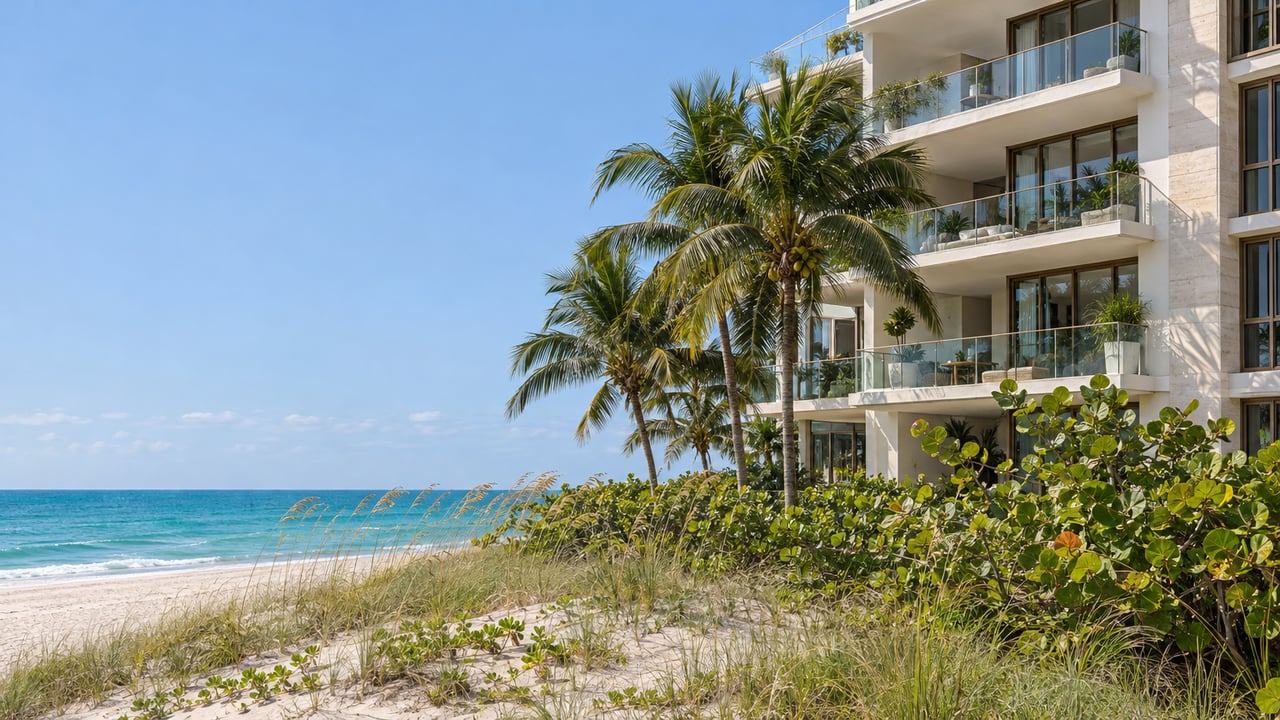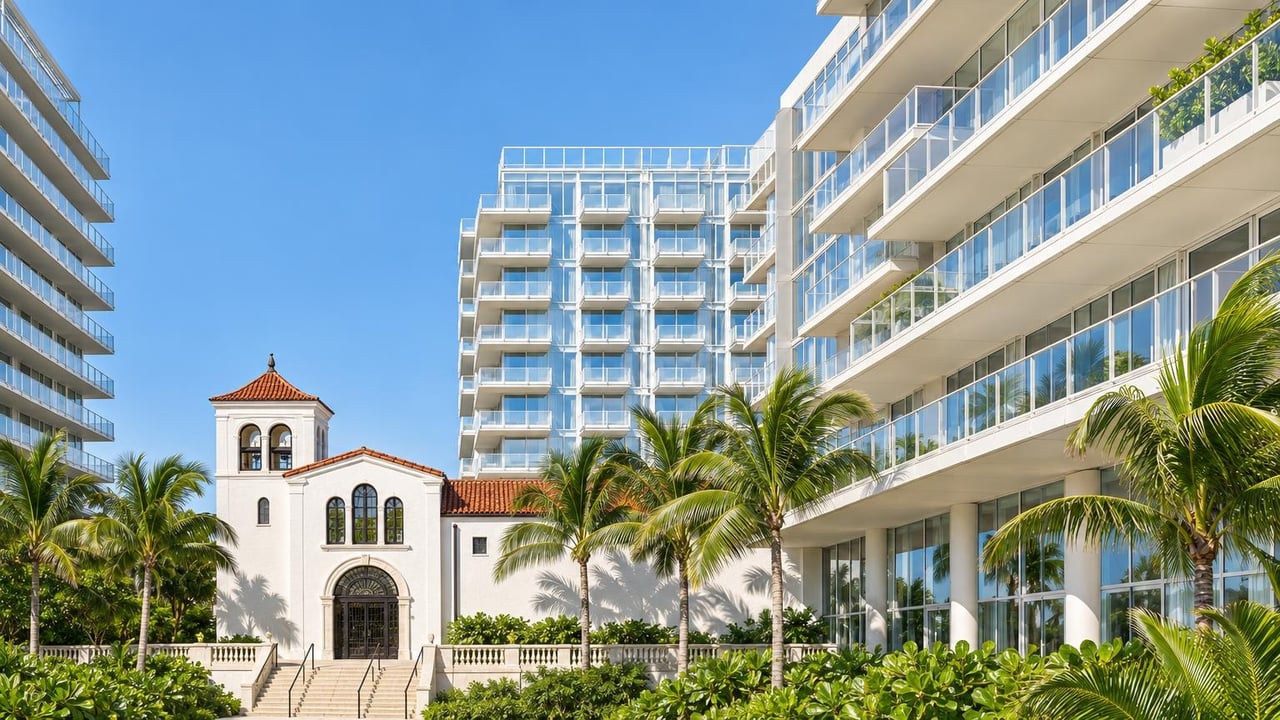
In the third quarter of 2026, the typical Surfside condo sale got more expensive and the average sale got much cheaper. Florida Realtors' Q3 2026 town-level report, published by MIAMI Realtors, puts Surfside's median condo price at $1.19 million, up 12.8% from Q3 2025. The average sale price in the same quarter was $3.75 million, down 26.3%. One quarter of data, and the two headline numbers point opposite ways.
That gap is the most useful thing to understand about buying a condo in this small oceanfront town. Surfside trades as two markets that share a zip code. At the top, a few branded oceanfront residences set the average. Below the median, a buyer's monthly costs set the price. The two groups of buyers are weighing different things, and a figure from one tier says almost nothing about the other.
A few closings on one campus decide the average
Surfside is a small condo market. The town recorded 18 condo closings in Q3 2026, down 28% from the same quarter last year, and 15 of those 18 were cash purchases. With so few sales, one $20 million closing moves the average by more than a million dollars. The median, which is the sale in the middle of the line, hardly moves.
Most of those large closings happen in one place: the Four Seasons at The Surf Club campus on Collins Avenue and the Seaway residences next to it. The Real Deal reported a $44 million Surf Club penthouse purchase in March 2026 at nearly $8,000 a square foot. In April, a south-tower Surf Club unit closed at $20.5 million, or $4,420 a square foot, according to The Real Deal. Its August 11 deals roundup listed another Surf Club unit at $19 million, or $4,800 a square foot. By early May, the ten-residence Seaway North had closed about $386.4 million in sales, an average of $38.6 million per home, at roughly $4,625 to $7,414 a square foot, The Real Deal reported.
Set those trades against the quarterly data and the swings make sense. In Q1 2026, a Corcoran report cited by The Real Deal showed Surfside condo sales up 57% and inventory down 25%, with the average sale pushed to $6.1 million, a 23% annual gain the outlet credited to strength at the high end. By Q3 the average was $3.75 million. Surfside condos did not lose a third of their value between spring and summer. Fewer Surf Club-level closings happened to land in the summer quarter.
The ratio tells the same story. In Q3 2026 the average was a little over three times the median. Working back from the report's year-over-year changes, the Q3 2025 average was roughly $5.1 million against a median of about $1.05 million, close to five times. The top tier pulled back a little in the summer and the middle firmed up, and the average reports both shifts as one number.
At the top, buyers pay for the finished campus
The clearest proof that the top tier runs on its own logic is a project a few blocks from the Surf Club. The Delmore is DAMAC Properties' planned 12-story, 37-residence building at 8777 Collins Avenue, the former Champlain Towers South site, with launch pricing from $15 million and typical prices reported at $35 million to $40 million. DAMAC bought the site for $120 million at a court-ordered auction in 2022.
In April 2026, The Real Deal reported that the project had not sold a unit since sales opened in early 2025. A DAMAC executive pointed to a rushed first launch and a delayed sales center, and said the firm had turned down more than $200 million in contracts over concerns about where the funds came from. DAMAC told the outlet it was resubmitting its master building permit, lining up insurance and a general contractor, and planning to relaunch sales toward the end of 2026, possibly with a joint-venture partner. In its July coverage, the outlet still described the project as having no buyers.
The same reporting says buyers at $15 million and up are active in Surfside and are buying at the Four Seasons at The Surf Club and its sister developments. So demand in this tier is there. What it goes for is a finished, branded address with neighbors already in place, and it will pay more per square foot for that than for oceanfront land alone. The Real Deal noted that a lower-floor Surf Club south-tower unit traded at about $4,400 a square foot, more than some new projects on the sand.
The town has its own work at that corner. At its August 6, 2026 meeting, the Surfside Town Commission gave final approval to the permanent Champlain Towers South memorial at the 88th Street street-end park, with a budget of about $3.5 million that includes a $1 million state grant, according to the Town. Anyone weighing a pre-construction contract on that block should ask the developer directly about the project's permit, contractor and delivery schedule on the day they sign.
Below the median, the monthly bill sets the price
A buyer looking at $1.19 million is in a different market from a Surf Club buyer, and the main question is what the unit costs every month. Age is the backdrop. As of 2023, about three-quarters of condos in Miami-Dade, Broward and Palm Beach counties were built in or before 1993, according to University of Florida estimates cited by the Miami Herald, and running costs for that stock have climbed fast.
The Miami Herald reported in June 2026 that average commercial insurance premiums for Miami-Dade condo associations rose from $175,000 at the start of 2021 to $462,000 by the end of 2024, citing Florida International University's Metropolitan Center. The same Herald piece said association fees for condo buildings of three or more stories rose an estimated 42% from the start of 2022 to 2025, and average individual condo owner policies rose from $1,600 to $2,300 over the three years ending in late 2024. These are countywide figures rather than Surfside-only numbers, and they are the costs a resale buyer below the median is pricing in.
The Herald quoted Nick Miceli, TD Bank's Southeast Metro regional president, saying these costs have "fundamentally changed the math for buyers," and that for many, a condo's monthly fees, insurance and the risk of future assessments now matter more than its sticker price. In Surfside, that means two units listed at the same price can be very different purchases. A building with its reserves funded and its major work done is pricing in a monthly fee the buyer can see. A building with that work still ahead may look cheaper on list price and cost more over five years.
This is also why the median and the average moved in opposite directions: the median follows buildings priced on association fees, insurance and repair history, while a handful of residences priced on a hotel brand and a finished campus drive the average, so neither number explains the other.
These figures are general market information, not legal, tax or financial advice. Confirm the costs for any specific building with the right professional before you commit.
What the Q3 pace says about leverage
The town-wide pace figures speak more directly to negotiation. In Q3 2026, Surfside condos took a median 62 days to go under contract and sellers received 94.0% of their original list price. At the end of the quarter there were 76 active condo listings, equal to 13.6 months of supply.
Over a year of inventory at the summer sales pace gives buyers room. Inventory is not spread evenly, though. The top-tier campus sells a very limited number of residences, and its buyers paid more per square foot through 2026, not less. Most of the leverage those 13.6 months suggest sits in the resale tier, where a buyer who has read the building's financials can make a firm case for price.
Timing also matters in a town this size. With roughly 18 closings in a quarter, a single listing priced well in a well-run building can move quickly while similar units nearby wait. The quarterly numbers set the general direction. The building's own numbers decide the deal.
Matching the number to your tier
A buyer under about $2 million should use the Surfside median and the days-on-market figure, and put the town average aside. The questions for that tier are building-level: what the monthly association fee covers, when the building's last major repair cycle ended, and what its insurance renewal looked like. Our earlier piece on choosing between a Surfside condo and a single-family home covers how those carrying costs compare with owning a house in town.
A buyer at $15 million and up is pricing against the Surf Club and Seaway trades listed above, at roughly $4,400 to $8,000 a square foot through 2026. In that tier, scarcity and a delivered product have outweighed the quarterly swings, and the price per square foot of the last closing on the campus is the useful benchmark. Buyers comparing branded oceanfront options along the barrier island can also look at our Bal Harbour condo price-per-square-foot guide and our current new-development listings.
Between those tiers, Surfside has fewer trades and the numbers are noisier. A 2026 average that moved from $6.1 million in the first quarter to $3.75 million in the third tells a buyer in that range very little. Recent closings in comparable buildings tell them more. More about the town itself is on our Surfside neighborhood page.
If you are pricing a Surfside condo this season, as a buyer or a seller, Carolina Bustillos P.A. can walk through the building-level numbers behind your tier, from association finances to the most recent comparable closings. Schedule a private consultation and we will prepare a Surfside-specific read before you make an offer or set a price.